Content Library
Podcasts

In this episode, Chukwuma Ukegbu, Global Head of Sales and Partnerships at Kora, explores how seamless payment infrastructure is unlocking growth across Africa’s hospitality and travel sectors. From solving cross-border transaction challenges to enabling better guest experiences, the conversation dives into the critical role fintech plays in scaling businesses across the continent. Chukwuma also shares how Kora is bridging global and local payment ecosystems, what the future of digital payments in Africa looks like, and why partnerships like FHS Africa are key to accelerating innovation and investment in the industry.

In this episode, we sit down with Tobias Reinecke, Head of Development, Investment & Portfolio Growth at Choice Hotels International, to explore the brand’s strategic expansion into Africa. With more than 7,000 properties worldwide, Choice Hotels is setting its sights on Africa’s dynamic hospitality landscape, beginning with Kenya as its first key market. Tobias unpacks the motivations behind this move, the continent’s unique development potential, and how Choice plans to balance franchise growth with sustainable local partnerships

In this episode of the FHS Podcast, Andrew McLachlan discusses the evolving landscape of the African hospitality industry. From increasing investment opportunities to emerging destinations, the African continent is showing promise like never before. He also discusses how East Africa is becoming one of the top choices of investors looking to invest in Africa,
Video Insights

Frank Wagner, Director of International Sales at ACT Hospitality Group, presents on the importance of technology investments in hospitality. He highlights how technology is crucial for improving guest experiences, increasing revenue, and reducing costs. Frank explains that the return on investment (ROI) for technology is multidimensional, covering not only financial gains but also operational benefits such as risk mitigation and enhanced guest satisfaction.

Jad Shamseddin, Chief Operating Officer, Aleph Hospitality, discusses the benefits of independent hotel management companies, emphasising the advantages of clustering multiple properties under various brands. He highlights how this approach can optimise revenue management, reduce costs, and improve operational efficiency.
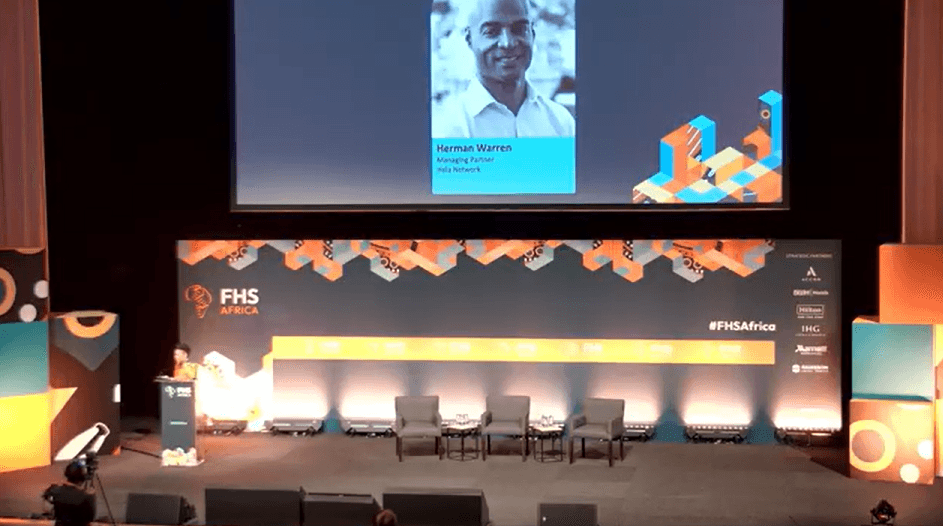
Herman Warren of Hela Network draws parallels between the challenges in the hospitality industry and the lessons learned from boxing and leadership. Using Mike Tyson's fall from grace and Nelson Mandela's resilience as examples, Warren emphasises the importance of staying focused on principles, adapting to disruptive events, and consistently investing in what truly matters. He addresses the global economic shifts shaping Africa's hospitality sector, highlighting the need for strategic, long-term thinking amidst uncertainty.
Press room

Uganda will host the Future Hospitality Summit (FHS) Africa for the first time on 2–3 February 2027, marking a major milestone for the country's tourism and hospitality sector and reinforcing its ambition to become one of Africa’s leading investment destinations.

CityBlue Hotels, one of Africa’s fastest-growing hotel groups, has selected UK-based platform Inntelo AI to deploy AI-native concierge agents across its portfolio, marking a significant step in the group’s strategy to lead the next phase of hospitality innovation across the continent. The announcement will be unveiled at the Future Hospitality Summit Africa taking place in Nairobi on 31 March 2026.

Agreement delivers a diversified pipeline of internationally branded and white-label hotels and resorts across Ethiopia’s key growth destinations.
Reports

Nairobi had something to say on Day 2 of Future Hospitality Summit Africa 2026, and the room was listening. The dialogue moved decisively from speculative optimism to the hard mechanics of asset activation, with global investors and regional leaders challenging each other to replace the comfortable language of "potential" with a more sophisticated framework for capital deployment.

FHS Africa landed in Nairobi this week with 450+ of the industry's most influential voices in the room. The conversation has shifted decisively from recovery to a radical redefinition of what hospitality means for the continent.

In frontier Africa, hospitality capital rarely moves on demand narratives alone. It moves when a project is deliverable, and an operating asset is governable.